A solid wood chest of drawers is one you can judge by the parts you cannot see from across a showroom: the drawer box, the joinery holding it together, and the wood the case is cut from. Those three things decide whether a chest still slides smoothly in thirty years or sags in three. This guide walks through each decision in the order you will make it.
What “solid wood” means on a tag, and what it does not
Three very different constructions share those two words in furniture listings. Solid hardwood means the visible boards were milled from a log and joined edge to edge. Veneer is a thin slice of real wood glued over a core of plywood, particleboard or fiberboard, so the face is wood and the body is not. Laminate is a printed image of grain under a plastic coating, and no part of it grew on a tree.
None of those is dishonest by itself. Cabinetmakers have used veneer for centuries to wrap a wide panel in figured grain that would crack if it were cut as a solid board. What matters is knowing which one you are carrying home, because that decides whether the piece can be sanded and refinished in twenty years or has to be thrown out. Our guide to how to tell real wood from veneer shows you where to look: the end of the top, the edge of a drawer front, and the inside of the case.
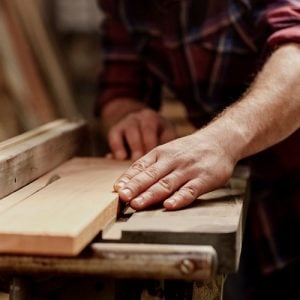
A solid hardwood chest is heavier than it looks, sounds dull rather than hollow when you knock on the end panel, and shows the same grain running over the top edge and down the side. At Charleston Amish Furniture, the casegoods on the floor — the trade word for furniture built as a box, meaning chests, dressers and nightstands — are built to order in Amish family workshops in Ohio, Pennsylvania and Indiana. How these chests are built is the part of the story the showroom will slow down and explain for as long as you want to hear it.
Start with the wood, because everything else follows it
The wood sets the color, the weight, the grain and how well the top shrugs off a dropped hairbrush. Furniture makers compare species on the Janka hardness scale, a standard test that presses a steel ball halfway into a board and measures the force it takes. A higher number means the surface resists dents better, though no wood is dent-proof and a little honest wear is part of why people keep these pieces.
Among the American hardwoods used for bedroom furniture, oak is open-grained and hard-wearing, with a grain pattern you can feel under your hand. Maple is pale and close-grained, and takes a painted or tinted finish evenly. Cherry arrives a light honey color and darkens to a deep reddish brown over its first year or two in the room, which surprises people who expected the showroom color to stay put. Walnut is already dark and tends to lighten a little. Hickory is the hardest of the common furniture woods and swings dramatically between pale sapwood and tan heartwood, sometimes in the same drawer front.
The specialists here work with nine hardwoods, including live-edge slabs that keep the natural outline of the tree and reclaimed barnwood with the nail holes and saw marks left in. Bring a drawer pull, a flooring sample or a photograph of the room and a specialist will put real boards next to it, because wood never looks the same under showroom light as it does on a screen.
The drawer box is where the work shows
Pull a drawer all the way out and turn it over. That one move tells you more than any tag. Look first at the corners where the drawer front meets the sides. A dovetail joint cuts interlocking wedges into both boards so they lock against the exact pull a drawer gets every day; a joint held with staples, glue blocks or a plain butt seam is relying on the fastener alone, and fasteners work loose in a drawer that opens twice a day for thirty years.
While the drawer is in your hands, check four more things:
- The sides. Solid hardwood sides, roughly half an inch thick, stay square. Thin fiberboard sides bow outward once the drawer is loaded with sweaters.
- The bottom. A solid or thick plywood bottom set into a groove carries weight. A thin panel stapled to the underside is the first thing to sag.
- The inside. Sanded smooth and finished inside means the maker expected you to look. Rough, raw interiors snag fabric and hold odors.
- The underside of the drawer front. Grain and color should continue around the edge rather than stopping at a glued-on strip.
Between the drawers, run your hand into the opening. A dust panel is a thin divider between one drawer and the next. It keeps dust out, stops a sock from riding over the back of the drawer below, and adds rigidity across the case. It costs the workshop time, which is exactly why it is a reliable signal.
How the case holds itself together
The case is the box the drawers live in, and it has one hard job: stay square while the wood inside it moves. A mortise and tenon joint, where a shaped tongue on one piece fits a matching slot in another, is the traditional way to tie a frame together, and the glue plus the mechanical fit does the holding rather than a screw. Dovetailed or dadoed case corners do the same job at the top and bottom.
Then look at the back. A solid wood or thick plywood back, screwed into a rabbet cut around the case, braces the whole piece against racking. A stapled cardboard back does not, and a chest with one will slowly rack out of square under its own load. Ask whether the back is finished; in an open floor plan the back of a chest is sometimes the first thing you see from the hall.
One more detail separates a piece built to last from one built to ship: the floating panel. A wide board swells and shrinks across the grain as humidity changes. A panel held loosely in a grooved frame can move with the seasons. A panel glued or screwed tight at every edge cannot, so it splits. That single idea explains most of the joinery in a well-built chest.
Glides, and how a drawer should feel
Open and close every drawer in a chest you are considering, loaded if the showroom will let you. Wood-on-wood glides, where a center runner guides the drawer along waxed hardwood, are quiet, repairable with a candle stub, and the traditional choice. Full-extension metal glides, usually mounted underneath, let you reach the back corner and often close themselves with a soft-close damper. Neither is wrong. Ask which glide a given workshop uses on the chest you like, and try it before you decide.
A drawer that is built right stops flush, does not tip when you pull it out two-thirds of the way, and sounds like a soft thump rather than a rattle. If a drawer has to be lifted or wiggled to close in a showroom, it will not improve in your bedroom.
Finish, color and the sheen you will live with
The finish is the only part of the chest you touch. It has to resist a wet glass, a dropped earring and ten thousand hand prints around the pulls. Many hardwood casegoods wear a catalyzed finish, a two-part coating that cures hard rather than simply drying; ask which finish the piece you like carries. Sheen matters more than people expect: a satin or matte surface hides fingerprints and small scratches, while a high gloss shows every one of them under a bedside lamp.
There are more than 180 finishes to choose from, and a workshop can match a color you bring in, which is how a new chest ends up standing beside a dresser your grandmother owned without either one looking wrong. Samples in the finish library are sprayed on the same species you are ordering, because the same stain reads warm on oak and cool on maple. Take two or three samples home and look at them at night, under the lamp you actually use.
Hardware, size and where the chest will stand
Hardware is the jewelry, and there are more than 1,000 styles to try: forged iron, brushed nickel, antique brass, wood knobs turned from the same board as the drawer fronts. Hold two or three against the finish sample before you commit, because a pull that looks delicate on a card can look undersized on a wide drawer.
Size is where built-to-order earns its keep. A chest can be made taller, shallower or wider to fit between a window and a closet door, and the drawer layout can change with it: two shallow drawers at the top for jewelry and watches, deeper ones below for sweaters. If you are deciding between forms, our companion piece on tall chests, tallboys and dressers lays out which one fits which wall, and blanket chests and trunks covers the low storage that works at the foot of a bed.
Measure the room before you fall in love with a piece. Note the ceiling height, the swing of the door, the height of the window sill and the width of the stair turn the delivery team will have to make. If the chest is part of a larger plan, a poster bed and the pieces around it shows how the forms stack up in one room, and getting the guest room ready covers the smaller version of the same problem.
How a solid wood chest of drawers behaves in Lowcountry humidity
Wood is still a living material after it is cut. It takes on moisture in a Charleston August and gives it back in January, swelling and shrinking across the grain while barely moving along it. That is normal, and a chest built with floating panels and proper joinery is designed to allow it. What causes trouble is a sudden swing: a house shut up and unconditioned for two weeks in summer, or a chest standing over a floor vent.
A few habits keep a chest steady here:
- Keep indoor relative humidity between 25 and 45 percent, with air conditioning in summer and a humidifier in winter, rather than letting it swing with the seasons.
- Stand the chest a couple of inches off an exterior wall so air can move behind it.
- Keep it out of direct sun; strong light will fade a finish and shift the color of the wood unevenly.
- Dust with a slightly damp cloth along the grain, blot spills right away rather than wiping them, and polish about once a month with a wax-free, silicone-free polish.
The seasonal detail lives in two companion pieces: keeping solid wood steady through a Lowcountry winter and the showroom’s own furniture care page, which is the one to follow if advice anywhere else contradicts it.
Who builds the chest, and what else is on the showroom floor
The chests are built by Amish families in small workshops rather than on a production line, and the store visits the shops it buys from, so a specialist can tell you which workshop made the piece in front of you. The workshops stay off the public utility grid, a choice rooted in how these communities order their lives, and they run their machinery on diesel, compressed air and hydraulic power instead. The work is precise and unhurried, and the makers are named rather than anonymous: Arista Wood in Sugarcreek, Ohio and the Ohio Furniture Guild in Millersburg, a network of Ohio builders and finish shops, are two of them.
Not everything on the 35,000 square feet of showroom floor comes from an Amish workshop, and the staff will tell you so. Upholstery and accents come from Smith Brothers of Berne, Indiana, building since 1926; Rowe of Salem, Virginia, since 1946; Natuzzi in Italy; and Uttermost. The outdoor furniture is LuxCraft poly lumber made from recycled HDPE, a dense recycled plastic that stands up to salt air, paired with Sunbrella cushions. Knowing which is which is part of buying well.
From the written specification to the room it stands in
A chest like this is built to order rather than pulled off a warehouse shelf. You sit down with a furniture specialist, choose the wood, the finish, the hardware, the fabric where there is fabric, and the size, and you leave with a written specification and a build time for that order. Build times are quoted per order rather than as a blanket promise, because each workshop’s queue is its own. Our piece on what built-to-order actually means walks through the sequence from first sketch to delivery.
Design help in the showroom or in your home is complimentary. When the piece is ready, a white-glove delivery team brings it into the room it belongs in, assembles it and sets it in place; pieces are inspected before they ship. Guardsman protection plans are available if you want one, and the most popular five-year plan covers up to $30,000 of furniture. Special financing is available with approved credit through a store credit card issued by Wells Fargo Bank, N.A.; the offers change, so ask a specialist to explain the current one, and the financing page covers how the card works.
What to bring when you come in
Three things make a showroom visit productive: measurements of the wall and the room, a photograph of what the chest will stand beside, and a clear sense of what you store. A person who keeps folded sweaters needs different drawers than a person who keeps shirts and belts. Browse the collections before you come if you like to arrive with a shortlist, or arrive with nothing at all and let a specialist start from the room.
Charleston Amish Furniture is at 1750 Sam Rittenberg Boulevard in West Ashley, open Monday through Saturday from 10am to 6pm and closed Sunday. The first store opened in Landrum, South Carolina, in 2005 and the Charleston showroom in 2017, and the team carries more than 100 combined years in home furnishings. More than 170 customers have left positive reviews on Google, Facebook and Yelp. You can contact the showroom at (843) 225-2513 before you drive out, or read how customizing a piece and caring for it works.
A chest of drawers is one of the few pieces of furniture that gets handled every single day, which is why the parts you cannot see are the ones worth asking about. Take your time with the wood, open the drawers, look at the back. Built once. Kept for good.
Frequently asked questions
How long do solid wood drawers typically last?
A well-built hardwood drawer with dovetailed corners and a solid bottom is measured in decades, not years, and plenty of antique chests are still in daily use after a century. What fails first is almost never the wood; it is the glide, the glue or a stapled joint. Those are repairable on a solid wood drawer and often not on a fiberboard one, which is the practical difference between a piece you keep and a piece you replace.
What was the old term for a chest of drawers?
Several, depending on where and when. In American usage a chest of drawers is often called a bureau, and in antique dealing a tall chest raised on legs is a highboy and its low companion a lowboy. A tallboy, the British term, is a chest-on-chest, two cases stacked one on the other. The form itself grew out of the lidded storage chest, once makers started fitting drawers into the base.
Where can I find a solid wood chest of drawers near Charleston?
Charleston Amish Furniture’s showroom is at 1750 Sam Rittenberg Boulevard in West Ashley, open Monday through Saturday from 10am to 6pm and closed Sunday. Chests there are built to order in Amish family workshops, so what you see on the floor is a starting point for wood, finish, hardware and size rather than the only version available. Call (843) 225-2513 if you want to know what is on the floor before you drive out.
Where can I find affordable dressers?
On a built-to-order chest, cost moves with the wood species, the size, the number of drawers, the finish and the hardware, so the same design can be specified several ways. Nothing is priced online; a furniture specialist prices your specification in the showroom and writes it down, so you can compare it honestly against anything else you are considering. Choosing a less expensive hardwood or a smaller footprint is usually the biggest lever.
What is the difference between a chest of drawers and a dresser?
A chest of drawers is tall and narrow, usually four to six drawers stacked in a single column, and it fits a wall where a wide piece will not. A dresser is low and wide, often with two or three columns of drawers and room on top for a mirror or a pair of lamps. Most bedrooms end up using both: the dresser carries the surface area and the chest carries the volume.