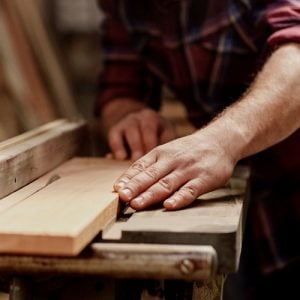
Ask which wood holds up best in Charleston’s humidity and the honest answer comes in two halves. Among the hardwoods we build with, cherry and black walnut move the least as the air swings from damp to dry; hickory and white oak move more, but they shrug off the hardest knocks. The larger factor is how the piece is put together. Built right, any of these woods will live well in a Lowcountry house for decades.
Which wood holds up best in a Lowcountry house: the short answer
Here is how the hardwoods people ask about most compare. Hardness comes from the Janka hardness scale, a standard test that presses a steel ball halfway into a board and records the force it takes, so a higher number means a surface that resists dents better. Movement is a separate question. It describes how much a board swells and shrinks as the moisture in the air around it rises and falls.
| Wood | Hardness (Janka, approximate) | Seasonal movement | What it looks like |
|---|---|---|---|
| Hickory | 1,820 | High | Pale and caramel streaks in one board |
| Hard maple | 1,450 | Moderate to high | Creamy, tight, almost grainless |
| White oak | 1,360 | High | Tan and olive, ray fleck when quartersawn |
| Red oak | 1,290 | Moderate | Open pink-brown grain |
| Black walnut | 1,010 | Low | Chocolate with purple and gray tones |
| Black cherry | 950 | Low | Smooth red-brown that deepens with age |
If the piece you have in mind is a dining table, our guide to choosing an Amish dining table in Charleston carries the same decision through size, seating and the day it arrives.
What humidity actually does to solid wood
Wood never stops trading moisture with the air around it. When the air is damp, a board takes moisture on and swells. When the air dries out, it gives moisture back and shrinks. That happens across the grain rather than along the length, which is why a wide tabletop changes slightly in width over a year while its length stays put.
Here is the part most advice about humid climates leaves out. The air that matters is the air inside your house, not the dew point on the driveway. A Charleston home with the air conditioning running all summer is usually drier indoors than out, and then the heat comes on in January and dries it further. Your furniture lives through that indoor swing, and the swing is what causes trouble, not dampness on its own.
Lumber is dried before anything is cut, and the finished piece keeps responding to the room it sits in. A table that feels a hair tighter in February and a hair wider in August is doing exactly what solid wood does. Our companion piece on keeping solid wood steady through humidity, heat and sunlight covers the habits that keep that movement gentle.
Oak: the workhorse, and what separates white from red
Oak is the wood most people picture when they picture a solid table. It is hard, heavy and strongly figured, and that busy grain is forgiving. Homework, keys and a dropped fork disappear into oak in a way they never do on a plain surface.
Red oak has open pores and a pink-brown cast. It drinks stain readily, which makes it the easier of the two to match to a floor or to a piece you already own. White oak is denser and cooler in tone, closer to tan and olive-brown, and its pores are naturally plugged, which is the reason coopers built barrels from it. That closed structure gives the surface a little more resistance to standing water, though no species and no finish make a tabletop waterproof.
Both oaks move a fair amount with the seasons. Quartersawn white oak, sawn so the growth rings run roughly perpendicular to the face, moves noticeably less across its width and shows the ray fleck that mission and craftsman pieces are known for. If you want oak and you want calm, that is the way to buy it. You can see the tone at work in this chevron oak bed and dresser.
Cherry: the wood that changes color on its own
Cherry is the one that surprises people. A new cherry table can arrive a pale pinkish tan and, over a few months of daylight, deepen into the warm red-brown everyone pictures. Light does that, not the finish. The change is permanent, it is even, and it is the main reason cherry is worth living with.
It has one practical consequence in the first year. Anything left in the same spot on a new cherry top, whether a runner, a bowl or a stack of mail, shields the wood under it and leaves a pale shadow when you move it. Shift things around for the first few months and the color evens out on its own.
Cherry is softer than oak, so it takes dents more easily, and most owners come to read those marks as the record of the table rather than as damage. It is also one of the steadiest woods in this climate, with a closed grain that feels finished before any finish is on it. Seeing boards next to the finish options in daylight is the only reliable way to choose a tone, because the cherry you pick today is not the cherry you will have next spring.
Walnut: dark, calm and steady in a damp climate
Black walnut is the one common American hardwood that is already dark all the way through. The color is in the wood rather than in a stain lying on top of it, so a scratch on walnut shows brown instead of a pale line. The tone runs chocolate with purple and gray undertones, and it sits comfortably next to almost anything else in a room.
Walnut is middling for hardness, softer than oak and harder than cherry, and near the bottom for movement. That combination makes it one of the most forgiving choices for a wide top in a coastal house. Sunlight works on it in the opposite direction from cherry: strong light gently lightens walnut rather than darkening it, so a piece in a sun-filled room will mellow over the years.
One honest note. Walnut sapwood, the band nearest the bark, is nearly white, and shops treat it differently. Some cut it away, some blend it, some leave it in for character. Ask which you are getting. Walnut shows at its best across a wide slab, as in this walnut live edge bed.
Maple: the hardest pale wood, and the fussiest about finish
Hard maple is dense, tight and nearly without visible grain, creamy white with an occasional curl or bird’s-eye. It is harder than either oak, so it stands up extremely well to daily use, and it is the wood to choose when you want a surface that reads quiet rather than figured.
The complication is color. Because maple is so dense and closed, stain does not soak in evenly, and applied carelessly it blotches. Shops that work in maple either finish it close to natural, use a conditioner and a toner to carry color evenly, or paint it, which is why so many painted kitchen islands and painted dining bases start as maple underneath. A painted base under a maple tavern top is a common Lowcountry pairing for exactly that reason.
Maple also moves more than cherry or walnut. That is not a reason to avoid it. It does mean that in a wide top, the joinery has to be right.
Hickory: the toughest of the five, and the busiest to look at
Hickory is the hardest of the domestic hardwoods in regular furniture use. If dents are your main worry, a houseful of children or a table that doubles as a workbench for school projects, hickory is the most dent-resistant wood on the floor.
Its look is the thing to settle in person. A single hickory board can run from near-white sapwood to deep caramel heartwood with dark streaks between, and a tabletop made from several boards reads as a patchwork. Photographs flatten that contrast. A full table at scale, like this round hickory table with a matching hutch, tells you quickly whether you love it.
Hickory also moves the most of the woods here, so it rewards good construction more than any other species. In a well-built piece that is a non-issue. In a cheaply built one, hickory is the wood most likely to tell on it.
Live edge slabs and reclaimed barnwood on the coast
Two more options come up constantly in the showroom, and they behave differently from sawn boards.
A live edge top is a single slab with the natural edge of the tree left on it. Because it is one wide piece of wood rather than several narrower ones glued together, movement is concentrated instead of spread out, and a slab that was not dried patiently will say so eventually. Ask how long the slab was dried and how the base attaches to it: a well-made steel or wood base lets the top move rather than pinning it flat.
Reclaimed barnwood arrives with an advantage no new lumber has. It has already spent decades reaching a truce with the weather, and it comes with nail holes, saw marks and a surface no finishing schedule can imitate. We work in nine hardwoods, live edge slabs and reclaimed barnwood among them, and the shops behind them are named on the site; Arista Wood of Sugarcreek, Ohio is one of them.
How the piece is built matters more than the species
Every wood on this page swells and shrinks. The difference between a table that lives happily here for forty years and one that splits in its third winter is almost always construction, not species.
Three details to look for, whatever wood you choose:
- A top that is allowed to move. Tabletop fasteners that slide in a slot, or breadboard ends pegged through elongated holes, let the width change without splitting the wood.
- Floating panels. In a cabinet door or a bed panel, the panel sits loose in its frame instead of glued tight, so it can expand without pushing the frame apart.
- Real joinery at the stress points. Mortise-and-tenon joints where a leg meets an apron, and dovetailed drawer boxes, hold where staples and bare dowels work loose.
The solid wood pieces we build to order come from Amish family workshops in Ohio, Pennsylvania and Indiana, small shops powered off the grid by diesel, air and hydraulic equipment rather than utility lines. Our article on what happens inside an Amish family workshop walks through that joinery in detail, and how our furniture is made follows an order from the showroom floor to a finished piece.
Finish, sunlight and the Lowcountry year
A finish slows the exchange of moisture between wood and air. It does not stop it. What a good finish does is slow it evenly, which is why the underside of a tabletop is sealed as carefully as the top; a top finished on one face only takes moisture on faster from below and cups.
The habits that keep a piece steady here are unglamorous, and they work. Hold the house at a reasonably steady temperature and humidity year-round instead of letting it swing while you are away. Keep solid wood out of all-day direct sun, and away from a heat vent or a fireplace. Use coasters and trivets, wipe spills when they happen, and dust with a soft, dry cloth. Our furniture care page has the routine for each finish, and it is worth matching the finish to the room: a satin, hand-rubbed surface hides the small marks of a busy kitchen better than a high-gloss one does.
Porch, deck and poolside: when the answer is not wood
Everything above assumes the piece lives indoors. Outside, salt air, afternoon storms and direct sun make a different argument, and the honest answer for a Lowcountry porch is often not a hardwood at all. Any wood left outdoors needs regular upkeep to stay sound and to keep looking right.
That is why outdoor seating and dining here is mostly poly lumber. LuxCraft builds it from recycled high-density polyethylene, a dense plastic lumber that does not absorb water, rot or need refinishing, and it pairs with Sunbrella cushions made for sun and rain. The outdoor color options run from weatherwood and black through the sky blue and seafoam you see on Folly Beach cottages and Old Village porches in Mount Pleasant.
Choosing your wood at the West Ashley showroom
Wood is hard to choose on a screen. Species names mean very little until you are standing over two boards in the same light, with the finish you are considering on both of them.
Charleston Amish Furniture is at 1750 Sam Rittenberg Boulevard in West Ashley, 35,000 square feet of floor, open Monday through Saturday from 10am to 6pm and closed Sunday. You can sit down with a furniture specialist and work through the decision in order: the wood, then one of more than 180 finishes or a color matched to something you already own, then hardware from more than 1,000 styles, then the size that actually fits your room. Design help is complimentary, in the showroom or at your home, and you leave with a written specification and the build time for your piece. When it is ready, our white-glove team carries it into the room, sets it up and inspects it.
Not everything on the floor comes from an Amish workshop, and we would rather say so plainly. The upholstery and accent lines come from Smith Brothers of Berne, Indiana, Rowe of Salem, Virginia, Natuzzi and Uttermost, with more than 2,300 fabrics and leathers between them.
There is no hurry in any of this. A piece like this gets bought once. If you are planning a first visit, read what to bring to the showroom, or reach the showroom team with your room measurements and a few photographs whenever you are ready. Built once. Kept for good.
Frequently asked questions
Does solid wood furniture warp in Charleston’s humidity?
Solid wood swells and shrinks with the moisture in the air, and it does that everywhere, not only on the coast. Warping and cracking usually come from construction that fights the movement, or from a sudden swing, such as a house left closed up without climate control for a long stretch. A piece built with a top that is free to move, kept in a room held at a steady temperature and humidity, stays flat for decades.
Which wood is the most dent-resistant for a dining table?
Hickory is the hardest of the hardwoods in regular furniture use, followed by hard maple, then white oak and red oak. Cherry and black walnut are softer and mark more easily. If dents are your main concern, hickory or maple is the practical choice, and a strongly figured wood such as oak also hides small marks better than a plain, pale surface does.
Will cherry furniture keep getting darker forever?
No. Cherry darkens quickly during its first months of light exposure, then the change slows and effectively settles. The useful habit is to move placemats, runners and bowls around during that first year so the top colors evenly, rather than leaving a pale rectangle where something sat all summer.
Is white oak better than red oak for a coastal home?
They are closer than most comparisons suggest. White oak has naturally plugged pores, so its surface resists standing water a little better, and it is slightly harder. Red oak is more open-grained and takes stain more evenly. For indoor furniture in a climate-controlled house, choose on color and grain, and consider quartersawn white oak if you want the least seasonal movement across a wide top.
What is the best wood for porch furniture in the Lowcountry?
Outdoors, the better answer is often not wood at all. Poly lumber made from recycled high-density polyethylene does not absorb water, rot or need refinishing, and it handles salt air and afternoon storms without upkeep. If you want real wood on a porch, plan on cleaning and refinishing it on a schedule to keep it sound.