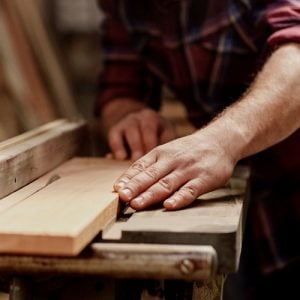
Amish furniture is actually built one piece at a time, on a bench, in a small family workshop in Ohio, Pennsylvania or Indiana. Hardwood is dried before it is cut, parts are joined with dovetails and mortise-and-tenon joints rather than staples, and the finish goes on in coats with sanding between them. At Charleston Amish Furniture, the order comes first: wood, finish, hardware and size are written down before a single board is touched.
Who builds the furniture, and where
The solid hardwood pieces we have built to order come from Amish family workshops in Ohio, Pennsylvania and Indiana. These are small businesses, often a shop building set behind the house or at the edge of a field, run by a family with a few employees from the same community. Woodworking is a trade there, learned in the shop from the people already working in it, and a shop’s reputation travels by word of mouth among the furniture stores that buy from it.
We know the shops because we go to them. Our craft page walks through how an order travels from the showroom floor to a bench and back. Among the workshops behind our hardwood pieces are Arista Wood in Sugarcreek, Ohio, the Ohio Furniture Guild in Millersburg, FN Chairs in LaGrange, Indiana, and Troyer Design Company. When a customer asks who made a piece, we can name the workshop rather than a factory and a country.
Scale matters more than any name. A shop with a handful of benches builds in small runs, which is why a table can be forty-two inches wide instead of forty-eight, why a drawer can be sized for the flatware you already own, and why a cabinet can be built to clear a baseboard that is not quite square. A production line cannot stop for that. A family shop can, because stopping for it is the work.
How Amish furniture is actually built, from rough board to finished piece
Every piece follows the same path, whether it is a trestle table or a nine-drawer dresser. Once an order leaves our showroom, the sequence in the shop looks like this.
- The specification. Wood species, finish, dimensions, hardware and any change to the standard design are written down and sent to the shop.
- Lumber selection. Boards are pulled for grain and color, then matched so a tabletop reads as one piece of wood rather than five.
- Milling. Rough boards are flattened, squared and cut to final dimensions.
- Joinery. Mortises, tenons and dovetails are cut, then fitted until each joint closes without a gap.
- Glue-up. Parts are clamped square and left to cure.
- Sanding. Every surface is worked through progressively finer grits. This is where a surprising share of the hours goes.
- Finishing. Stain or dye, a sealer, then topcoats, with a light sanding between coats.
- Fitting. Drawers are hung and adjusted, doors aligned, tops attached so the wood can still move.
- Inspection and packing. The piece is checked over, then wrapped for the trip south.
No step gets skipped to make a date. A piece is finished when it is finished, which is why build times are quoted per order rather than promised in advance.
The power in the shop is diesel, air and hydraulic
One of the most common questions we hear is whether these shops use power tools. They do. What they generally do not use is the public electrical grid.
A typical shop runs a diesel engine that drives a hydraulic pump, an air compressor or a line shaft. That power reaches the table saw, the planer, the wide-belt sander, the mortiser and the drill press through hydraulic lines and air hoses instead of wall outlets. The machines are much like the ones a cabinet shop in North Charleston would own. The energy simply arrives a different way, and that arrangement comes from the community’s own rules about connecting to public utilities.
This matters for two reasons. The first is accuracy. A planer and a wide-belt sander produce flat, consistent surfaces, and flat surfaces are what let a joint close tight. The second is honesty. A shop advertising furniture made only with hand tools is describing something other than how these pieces come together. The real work is a mix: machines for stock preparation and repeatable cuts, hands for fitting, sanding and judgment.
Solid hardwood begins with dry lumber
Wood moves. It takes on moisture when the air is damp and gives it up when the air is dry, and it moves across the grain far more than along it. Nearly every decision in a good shop is made around that fact, starting with the lumber itself.
Boards are dried before they are cut, usually in a kiln, until the moisture left in the wood is low and steady. Lumber that goes into a joint wet will shrink afterward, and the joint opens. That is the single biggest difference between a piece that stays tight for decades and one that develops gaps in its second winter.
We work in nine hardwoods, including live edge slabs and reclaimed barnwood. Oak is open-grained and hard. Cherry responds to light and ages toward a deep red-brown. Walnut is dark, lighter in weight and softer under a fingernail. Maple is pale, tight-grained and shows every mark. Hickory swings dramatically in color between heartwood and sapwood. If you are weighing species for a house here, which wood holds up best in Charleston's humidity goes through them one at a time.
None of these species is a mistake in the Lowcountry. The habits of the room matter more: how much light it gets, how hard the air conditioning works, and how often the door to the porch stands open.
The joinery that keeps a drawer sliding for decades
A drawer that still runs smoothly after thirty years is not luck. It is a dovetail joint doing what it was designed to do. A dovetail is a row of interlocking wedge-shaped pins and tails cut into the corners of the drawer box. Glue holds a plain butt joint together and nothing else does; a dovetail holds even when the glue finally gives up, because the shape of the joint resists the pull of the handle.
Table bases and case frames use mortise and tenon. A tenon is a tongue cut on the end of one piece; a mortise is the matching slot it seats into. The joint gives a large gluing surface and resists racking, the slow side-to-side wobble that eventually ends a chair or a table base.
The third piece of the puzzle is allowing movement. A solid tabletop forty inches across changes width by a visible amount between a damp August and a dry January. Tops are therefore attached with clips, buttons or screws in elongated holes, so the top can expand and contract while the base stays put. Breadboard ends, the cross pieces capping some tabletops, are pegged through slotted holes for the same reason. Screw a solid top down tight and it will crack, because it has no other way to go.
When you are in our showroom, pull a drawer all the way out and look at its corners, then crouch and look under the tabletop. The joinery tells you most of what you need to know.
Sanding, stain and topcoat
Finishing takes longer than most people expect, and it is where a piece is won or lost. The wood is sanded through finer and finer grits until the surface is even. Skip a grit and the scratches left by the coarser paper show up the moment stain touches the wood, especially on cherry and maple.
Color comes next. The same stain looks different on every species, which is why a sample is sanded and finished on the wood you actually chose rather than judged from a printed chart. We keep more than 180 finishes, and a shop can also match a color you bring in: a floor sample, a cabinet door from the kitchen, a piece you already live with.
Then come the protective coats. Sealer first, then topcoats, with a light sanding between them to knock down the grain that the finish raised. What you end up with is a surface built to stand up to water rings and to the warm, damp air that comes with living here. It is not indestructible. Nothing is. It is repairable, which matters more over thirty years.
The finish library is worth browsing before you come in. Narrowing to three or four colors ahead of time makes a Saturday on the showroom floor far easier.
What gets checked before a piece ships
A finished piece is inspected in the shop before it is wrapped. Drawers are opened and closed, doors aligned, the top sighted along its length for flatness, the finish read under raking light for runs and dust.
Then it travels. Furniture built in Ohio or Indiana crosses several climate zones on the way to the coast, which is why packing deserves as much care as the build itself.
Our own team takes it from there. White-glove delivery means the piece comes into the room where it will live, is assembled if it needs to be, and is set in place rather than left in a box in the driveway. The people carrying it in are the last set of eyes on the work, and they are looking. If you want the whole sequence, what happens the day your piece arrives covers it step by step.
If something is not right, we would much rather find it in the shop or on the truck than have you find it after a week of living with the piece.
What is Amish-built, and what comes from other American workshops
Not every piece on our floor comes out of an Amish shop, and we would rather say that plainly than let anyone assume otherwise. The solid hardwood tables, beds, chairs and casegoods are built to order by Amish families. The upholstery and the accents come from other makers, most of them American and most of them long established.
Smith Brothers of Berne, Indiana has been building upholstered furniture since 1926. Rowe has been doing the same in Salem, Virginia, since 1946. Natuzzi brings leather from Italy, and Uttermost fills in accents. On the upholstery side the decisions run differently, through more than 2,300 fabrics and leathers rather than wood species and stain.
Outdoor is its own category again. LuxCraft poly lumber from Sugarcreek, Ohio, is made from recycled HDPE, the high-density polyethylene used in milk jugs, colored all the way through rather than painted on the surface, and paired with Sunbrella cushions. It does not rot and salt air does not trouble it, which is what makes it suit a porch at Folly or an Old Village piazza.
Built to order, not Amish style
The words Amish style on a tag describe a look, not a maker. Nothing regulates the phrase, so a mass-produced piece with a Shaker taper and a dark stain can wear it comfortably. A few questions sort it out quickly.
- Ask who built it. A real answer names a shop and a town.
- Pull a drawer out. Look for solid wood sides, dovetailed corners and a finished interior.
- Look at the back of a case piece. Solid panels, not stapled hardboard.
- Ask what you can change. A built-to-order piece can change size, species, finish and hardware. A warehouse piece cannot.
- Ask where the lumber came from and how it was dried.
There is nothing wrong with buying off a showroom floor. Sometimes the room needs a sofa this month, and built to order or off the floor works through those trade-offs honestly, including the ones that favor stock. The comparison worth making is not sticker to sticker. It is one table that gets refinished once in thirty years against four that get carried to the curb.
What all of this means in a Lowcountry house
Our climate is hard on furniture. Humidity swings, strong summer light and the salt riding in on an east wind all work away at wood and finish. Built-to-order pieces hold up here because the material is solid and the joinery is designed to move, but they still want a little attention.
Keep a piece out of direct sun, or expect the color to shift. Cherry in particular darkens quickly in a south-facing window. Wipe spills instead of letting them stand. Dust with a soft, barely damp cloth and leave harsh or abrasive cleaners alone. Use mats under anything hot or wet. Keep indoor humidity reasonably steady, which usually means running the air conditioning the way you would for your own comfort. Our furniture care page has the full routine, and keeping a solid wood piece steady through a Lowcountry year follows the seasons month by month.
We also offer Guardsman protection plans. The most popular five-year plan covers up to $30,000 of furniture, and a specialist can walk you through exactly what it does and does not cover before you decide.
Come see the work in West Ashley
Photographs cannot settle a wood choice. Grain, weight, the way light travels across a finish: those get decided standing in front of the piece with a hand on it.
Our showroom at 1750 Sam Rittenberg Boulevard in West Ashley runs 35,000 square feet, open Monday through Saturday, 10am to 6pm, and closed Sunday. A furniture specialist will sit down with you, pull wood and finish samples, work against your room dimensions and write a specification you can take home with you: species, finish, size, hardware, fabric and the build time for your order. Design help, in the showroom or at your house, is complimentary. More than 170 customers have left positive reviews across Google, Facebook and Yelp, and the visits that produce them are rarely quick ones.
Special financing is available with approved credit through our store credit card, issued by Wells Fargo Bank, N.A. A specialist will explain the current offers in store.
If you are starting with the table, choosing an Amish dining table in Charleston covers wood, finish and size in the order you meet them. When you are ready to see the joinery yourself, plan a visit to the West Ashley showroom or call (843) 225-2513. Built once. Kept for good.
Frequently asked questions
Is Amish furniture actually made by the Amish?
The solid hardwood pieces we have built to order are made by Amish families in small workshops in Ohio, Pennsylvania and Indiana, and we can name the shop that built a given piece. The upholstery and accent lines on our floor come from other makers, including Smith Brothers, Rowe, Natuzzi and Uttermost, and our outdoor poly lumber comes from LuxCraft. We tell customers which is which, because the two are made in different places by different hands.
Do Amish furniture makers use power tools?
Yes. Table saws, planers, wide-belt sanders, mortisers and drill presses are all standard equipment in these shops. What is different is the energy source: the shops run off the public grid, using diesel engines, hydraulic lines and compressed air to drive the machines. Any claim that this furniture is made only with hand tools is describing a different kind of shop.
How do Amish woodworkers build furniture so quickly?
They mostly do not, and speed is not really the point. A small shop runs several pieces through the same stages at once, which keeps benches busy, and there is no corporate approval chain slowing an order down. Drying, glue curing and finish coats set a pace that cannot be rushed without showing up later in the piece. Build time depends on the shop, the season and your specification, so it is quoted for your order rather than estimated in advance.
Is Amish furniture worth the money?
That depends on how long you plan to keep it. A solid hardwood piece joined with dovetails and mortise-and-tenon joints can be tightened, repaired and refinished decades from now, which is not true of particle board with a printed surface. It is worth comparing one piece you keep against the several you would replace in the same span. We do not publish prices; a specialist quotes a piece once the wood, size, finish and hardware are written down.
What is the difference between Amish-made and Amish style furniture?
Amish style refers to a look, usually a clean Shaker or Mission silhouette, and anyone can use the phrase on any piece. Amish-made refers to who built it and where. Pull out a drawer and look at the corners, check whether the case back is a solid panel or stapled hardboard, and ask whether the size, species and finish can be changed. A built-to-order piece can answer all of those; a look-alike usually cannot.