A solid wood storage chest is one of the few pieces of furniture that works for a living while standing still. It holds the throws, the board games, the spare pillows and the hurricane-season odds and ends that otherwise end up in a closet on the other side of the house, then does a second job as a bench or a surface. Plenty of chests sold online are particleboard under a printed wood-look wrap, and photographs hide that well. Here is how to read one before you buy it.
What a Solid Wood Storage Chest Does That a Plastic Bin Cannot
Charleston houses were not built with storage in mind. Single houses on the peninsula, 1950s ranches in West Ashley and cottages out toward Folly share a shortage of closets, and none of them are where you actually sit. A chest solves that in the open, because it is furniture first and storage second.
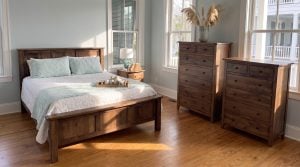
It also earns its footprint twice: the chest at the foot of a bed holds the extra quilt and gives you somewhere to sit while you put your shoes on. That is the argument for one good chest instead of three cheap bins.
Chest, Trunk, Hope Chest: What the Names Are Telling You
The words get used loosely, and the differences are mostly shape and history rather than quality.
- Blanket chest. A lift-top box, about the depth of a folded quilt, standing on feet or a plinth base. The most common form, and the one an older generation called a hope chest.
- Trunk. Borrowed from travel luggage, often with a domed or banded lid and corner hardware. Handsome, though a domed lid gives up its use as a seat.
- Storage bench. Lower and longer, built to be sat on.
The real fork in the road is lid against drawers. A lid gives you one deep cavity, which suits bulky soft things. Drawers give you sorted, shallow space, which suits clothing. If drawers are what the room needs, our buying guide to solid wood chests of drawers covers the woods, the joinery and the drawer boxes.
How the Box Is Built Tells You Most of What You Need
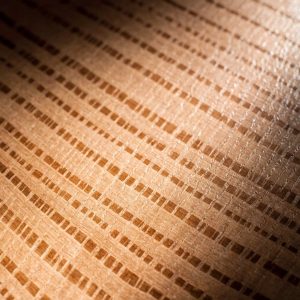
Open the lid and look at the front edge where it meets the box. On a solid piece you will see end grain, the open pores of a board cut across its length, and the figure carries around the corner. On a wrapped panel the grain stops dead at the edge, or repeats exactly on a second board.
Then check four things.
- Corner joinery. Dovetails or a mortise-and-tenon frame hold up under decades of being dragged across a floor. Staples and glue blocks do not.
- Panel construction. A side built as a frame with a floating panel inside lets the wood expand and contract without splitting the box.
- The lid. Ask how it is hinged and how it is held open. A heavy hardwood lid that falls freely is a hazard.
- The bottom. A solid base carries weight over years. A thin sheet stapled to the underside eventually sags.
This is where built to order parts company with built to a price. Charleston Amish Furniture works with Amish family workshops in Ohio, Pennsylvania and Indiana, including Arista Wood in Sugarcreek and builders in the Ohio Furniture Guild, a network based in Millersburg. Those shops run on diesel, air and hydraulic power rather than the public grid, and they build in small numbers rather than on a production line. How these chests are built goes further into the process.
Wood and Finish, the First Two Decisions
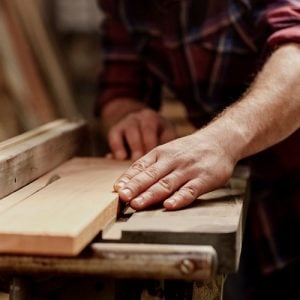
Every piece built to order starts with the same four choices: wood, finish, hardware and size. On a chest, the first two decide how it looks in ten years.
Hardwoods are not interchangeable. Open-grained woods such as oak carry a ridged pattern that forgives small dings. Tight-grained woods such as maple read smooth and calm, and show a scratch more plainly. Cherry starts pale and deepens toward a reddish brown as light reaches it. There are nine hardwoods to choose from here, including live edge slabs and reclaimed barnwood, and a specialist will put the samples in your hands rather than describe them.
Finish is what stands between the wood and a wet glass. More than 180 finishes are available, or a color matched to something you already own, and one wood can look like two species under two of them. The finish library gives you the range before you come in.
Size, Hardware and the Spot You Have in Mind
Measure before you fall for anything. Three numbers matter: the length of the wall or sofa the chest sits against, the depth that still leaves a walking lane, and the clearance above it, because a lid needs room to swing up. A chest tucked under a low window sill is the classic mistake.
Hardware is the fourth decision and the quickest way to change a piece’s character, with more than 1,000 styles, from forged iron strap hinges and lifts to plain brass. Because the chest is built for you, the dimensions move too: an inch shorter to clear a baseboard heater, a few inches taller to line up with a bed rail. You leave with a written specification and a build time for your order.
Keeping a Chest Steady in Lowcountry Air
Solid wood takes on and gives off moisture with the air around it, which is why frame-and-panel construction matters more here than in Ohio. Our summers are humid and the heat running in January is dry, and the wood feels both.
A few habits cover most of it. Keep indoor relative humidity between 25 and 45 percent year-round. Keep the chest out of direct sun and away from a heat register, since both dry one face faster than the other. Dust with a slightly damp cloth along the grain, blot spills right away rather than wiping them, and polish about once a month with a wax-free, silicone-free polish. Store only dry linens; a damp quilt in a closed box is bad for the quilt and for the wood. Our furniture care guidance has the full routine, and keeping solid wood steady through a Lowcountry winter takes on the heating-season swing in particular.
Come Lift a Lid in West Ashley
A chest is a piece you have to open. The showroom at 1750 Sam Rittenberg Boulevard runs to 35,000 square feet, so you can lift lids, feel the weight of a hardwood panel and hold finish samples against each other. Design help is complimentary, in the showroom or in your own room. Hours are Monday through Saturday, 10am to 6pm, closed Sunday.
Not everything on the floor comes from an Amish workshop. Upholstery comes from makers such as Smith Brothers, Rowe and Natuzzi, accents from Uttermost, outdoor poly lumber from LuxCraft, and a specialist will tell you plainly which is which. Special financing is available with approved credit, and a specialist can explain the current offers.
When your chest is finished, the white-glove team inspects it before it ships, then delivers it to the room it belongs in and sets it up. If the chest is one part of getting the guest room ready before the house fills up, say so early and it can be planned together. Reach the showroom online, or call (843) 225-2513. Built once. Kept for good.
Frequently asked questions
Can a storage chest be used as a coffee table?
Many people do, and a flat-lidded chest handles it well. Leave enough clearance in front of the sofa to lift the lid without moving the chest, and use coasters and trivets the way you would on any wood tabletop. A domed or banded trunk lid is the one shape that does not work for this, since nothing sits flat on it.
Does a blanket chest need a cedar lining?
It does not have to have one. Aromatic red cedar gives off an oil with a strong scent that is long associated with deterring clothes moths, which is why cedar linings became traditional for wool and linens. A chest in any hardwood stores bedding perfectly well as long as what goes in is clean and dry. Ask a specialist what lining options are available for the chest you are considering.
What should I avoid storing in a wooden chest?
Anything damp, and anything that needs air moving around it. A quilt or a beach towel put away even slightly wet will hold that moisture against the wood in a closed box. The same goes for items in sealed plastic bags, which trap condensation. Let linens dry fully, fold them, and leave a little room rather than packing the chest tight.
Is a hinged lid safe around small children?
It depends entirely on how the lid is held. A heavy hardwood lid on plain hinges can drop fast, so ask how the one you are looking at stays open before it goes in a room where children play. This is a reasonable question to put to a furniture specialist, and it is worth asking of any chest, whatever it is made of.