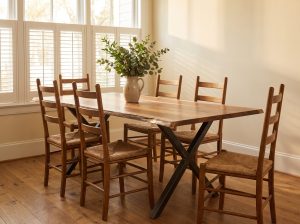
Here is the short version: to care for solid wood furniture through a Lowcountry winter, keep the air around it steady, keep it away from heat vents and hard winter sun, and dust it with a slightly damp cloth. Charleston hands a hardwood table a swing most of the country never sees. August holds moisture like a wet towel; a heated January room pulls that moisture right back out. The wood answers by moving a little. Understanding that is most of the job.
Why Wood Moves When the Heat Comes On
Hardwood is never completely still. It takes on moisture from humid air and gives it back when the air dries, swelling and shrinking across the grain as it does. In August, a West Ashley living room can sit at the damp end of that scale for weeks. Then a cold front arrives, the heat runs every evening, and the indoor air dries out faster than most people expect. A wide tabletop that felt snug in September can show a hairline seam by January and close it again in May.
That is normal, and no glue or finish prevents it. It is also why these pieces are built the way they are: breadboard ends that float, tabletop fasteners that slide in a slot instead of pinning the top down, drawer bottoms left free to expand. The Amish family workshops in Ohio, Pennsylvania and Indiana that build for us have been fitting joints around seasonal movement for generations, and you can see how that thinking shows up in our walk-through of how these pieces are built. Your job is to keep the movement small and even.
How to Care for Solid Wood Furniture Through a Heated Winter
Steady air does most of the work. Three habits cover it.
- Keep relative humidity between 25 and 45 percent. An inexpensive hygrometer tells you where a room actually sits, which beats guessing. Run a humidifier through the driest stretches of winter and the air conditioning in summer, and keep the room from swinging hard in either direction.
- Get pieces off the heat. A chest standing over a floor register, or a sideboard beside a space heater, dries on one face while the other stays damp. That uneven drying is what cups a panel or twists a door. Move the piece a foot, or redirect the vent.
- Watch the low winter sun. It comes in at a flatter angle and reaches much farther across a floor than summer light. Shift a rug, close a sheer curtain, or rotate a table a quarter turn every few weeks so one end does not lighten ahead of the other.
Cleaning Without Hurting the Finish
Most of the damage we see is not dramatic. It is a year of the wrong spray. Dust with a soft cloth that is slightly damp, working with the grain; a dry cloth can leave fine scratches. Blot spills right away rather than wiping them across the finish. About once a month, polish with a wax-free, silicone-free polish. Skip ammonia, bleach, all-purpose kitchen cleaner and wax, which builds up over time. Our furniture care page stays the reference; nothing here replaces it.
What is ideal depends partly on the surface. A catalyzed topcoat, an oiled surface and a painted finish do not want the same treatment, and we offer more than 180 finish options, so your dining table may not behave like your neighbor’s. If you are not sure which one you chose, the written specification from your order lists it. Upholstered pieces from makers like Smith Brothers, Rowe and Natuzzi follow their own fabric and leather care.
Drawers That Stick and Doors That Shift
A drawer that slid easily in August can run loose in January, and one that was fine in January can tighten in June. Solid wood drawer sides move with the season; that is the honest cost of a dovetailed hardwood box instead of a stapled one. Give it a couple of weeks for the air to settle before deciding something is wrong. If a drawer still binds, paraffin or plain candle wax rubbed on the runners usually settles it, and if it binds in every season, call us.
If you are still shopping and want to know what separates a drawer box that lasts from one that does not, start with our solid wood chest of drawers buying guide, which covers woods, joinery and drawer construction.
Linens, Candles and the Holiday Table
Winter is when the dining table works hardest here. A few small things protect it: trivets under anything hot, felt pads under candlesticks and ceramics, and a cloth or runner lifted off once the meal is over rather than left in place for a week, because a damp cloth holds moisture against the finish. Blot spills and condensation rings as they happen. Water sitting overnight is harder on a finish than a hot plate is.
Quilts and winter linens are their own storage problem once the guest room fills up. Cedar-lined and solid hardwood chests both work, and we weigh the trade-offs in our piece on blanket chests and trunks. Wherever they go, make sure textiles are dry before they go in, and leave a little air space rather than packing a chest to the lid.
Porch Furniture in a Lowcountry Winter
Outdoor season barely stops in Charleston, so most porch furniture stays out. The LuxCraft poly lumber we carry is made from recycled HDPE, a dense plastic lumber that needs no sealing, sanding or oiling, which is the main reason it suits salt air and humidity this well. Rinse it when pollen or salt builds up, wash it with mild soap and water, and bring Sunbrella cushions in dry. Real wood outdoor furniture is a different animal, and the questions below cover it.
When to Bring It to Us
If something does not look right after a season, we would rather see it than guess over the phone. Charleston Amish Furniture is at 1750 Sam Rittenberg Boulevard in West Ashley, open Monday through Saturday from 10am to 6pm and closed Sunday, and you can reach us at (843) 225-2513 or through our contact page. Bring a photo if the piece cannot come with you. Guardsman protection plans are available too; the most popular five-year plan covers up to $30,000 of furniture, and a specialist will walk you through what it does and does not cover.
Built once. Kept for good. A hardwood table that gets steady air, a slightly damp cloth and a little attention in January is the one your family will argue over in forty years.
Frequently asked questions
Can outdoor furniture be left outside in the winter?
In the Lowcountry most of it can. Poly lumber handles our winters without being stored away, and the real risks here are standing water and wind rather than a hard freeze. Solid wood outdoor furniture does better under a porch roof or a breathable cover. Bring cushions in dry and store them somewhere that stays dry.
How do I protect wooden outdoor furniture in winter?
Clean it, let it dry completely, then keep standing water off it. A breathable cover or a sheltered spot works better than a sealed tarp, which traps moisture against the wood. Put pads or feet under the legs so they are not wicking water out of wet brick or concrete. For sealing or oiling, follow the instruction that came from the maker of that piece. Our outdoor line is poly lumber rather than wood, so this is general guidance.
What is the best oil to use on outdoor wood furniture?
It depends on the species and on what is already on the piece, so the maker’s own instruction should decide it. Penetrating exterior oils are common on teak and similar dense woods, and they mainly slow the silver-gray weathering rather than prevent rot. Avoid layering one product over a different one. The outdoor furniture we carry is recycled poly lumber, which never needs oiling.
Does a new solid wood piece need time to settle after a winter delivery?
Give it a few days in the room before you judge it. A piece built in an Ohio or Indiana workshop arrives into air that is not the air it left, and drawers or doors can run slightly tight or loose at first. Let it sit where it will live, away from a vent. If something still is not right after a couple of weeks, call the showroom.
Where should I store dining table leaves over the winter?
Flat, and in the same room as the table so they share the same air. A leaf stored in a hot attic or a damp garage can come back a slightly different size and sometimes a slightly different shade. Many tables have a storage pocket or a padded bag; a dining room closet works too. Keep them out of direct sun.