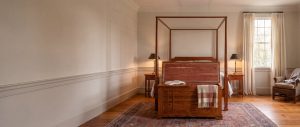
An Amish poster bed is a solid hardwood bed with four tall posts at the corners, built to order in a small family workshop rather than on a production line. It anchors a bedroom the way a dining table anchors a dining room, which is why the nightstands, chest and dresser around it matter as much as the bed itself. Here is how to choose the bed, then build the room around it.
What an Amish poster bed is, and how it differs from a panel bed
A poster bed takes its name from the four posts that rise at its corners. On a low-post bed those posts stop a few inches above the mattress and finish in a turned finial. On a high-post bed they can run most of the way to the ceiling. Put a frame across the tops and you have a canopy bed, sometimes called a tester bed, which can be left bare or draped.
A panel bed does the opposite. It puts its weight into a wide headboard and a low footboard and then settles back against the wall. A poster bed draws a box in the air. It gives the room four vertical lines that everything else has to answer to, which is a bold move in a small bedroom and a generous one in a large one.
The word Amish describes where and how the bed is built, not a single style. The workshops that build for Charleston Amish Furniture are small family shops in Ohio, Pennsylvania and Indiana, and the store visits them. They work in solid American hardwood and build to one customer’s written specification rather than to a warehouse order. That is why a shop can change a post height or a footboard profile for you: nothing is tooled for a run of identical beds. If you want to see the places and the people behind that, read how the workshops build these pieces and the makers behind each collection.
One honest clarification, because it comes up often: these shops work off the grid, but they are not building with hand tools alone. Diesel, air and hydraulic power run the saws, the lathes and the sanders. The craft sits in the wood selection, the joinery and the finish, not in doing everything the slowest way available.
Why the bed sets the scale for everything else in the room
Before you choose anything else, measure. A standard queen mattress is 60 by 80 inches and a standard king is 76 by 80. A poster bed sits outside that footprint, because the posts stand proud of the rails and the footboard reads taller than the low rail you may be used to. The bed takes up more visual room than its measurements suggest.
Walk the room with a tape measure. You want enough space on each side to make the bed without turning sideways, and a clear path to the closet and the bathroom door. In an Old Village bedroom with windows on two walls, there is often only one honest place for the bed, and the posts will frame whatever sits behind them.
Then think about height. Posts that stop short look hesitant under a high ceiling, and posts that run tall can crowd a nine-foot room, though a slim pencil post handles that better than a heavy turned one. Older Charleston houses often carry tall ceilings; most newer bedrooms in Summerville and out on the islands sit closer to eight or nine feet. This is the easiest decision to get right in person, standing next to the posts, which is what the collections on the showroom floor are for.
One more thing the bed decides: the rug. A poster bed on a rug that stops under the nightstands looks unfinished, so either run the rug past the foot of the bed or leave the floor bare and put a smaller rug on the side you get out on.
The four decisions you make with a specialist
Every piece in a bedroom comes down to the same four choices, and an Amish poster bed is where they show up most plainly. A furniture specialist takes them in order and writes the answers down, so the bed, the nightstands and the chest are specified as one room rather than as four separate purchases.
The wood
Nine hardwoods are offered, including live edge slabs and reclaimed barnwood. Red oak shows an open cathedral grain, named for its large arches, and takes a stain evenly. Maple is pale, tight and hard, and it shows a finish honestly, which is part of why it is a common choice for painted work. Walnut runs chocolate to purple-brown with pale sapwood near the edges of a board. Hickory swings from near-white to deep brown within the same board and is one of the harder domestic species. Furniture people measure that with Janka hardness, a test of how much force it takes to dent a wood. On the bed itself, the choice is mostly about color and grain. On the chest standing beside it, hardness also decides how the top survives ten years of keys, watches and reading glasses.
The finish
More than 180 finishes are available, and a color can be matched if none of them is right. A clear or natural finish lets the grain carry the piece, which suits walnut and live edge. A stain shifts the color without hiding the figure. Paint closes the grain and makes the form the subject, which is why a painted poster bed reads quieter in a small room than a stained one. The finishes offered in the showroom are much easier to judge on a sample board in daylight than on a screen.
The hardware
Hardware matters little on a bed, which usually has none, and a great deal on the chest and nightstands that follow it. More than a thousand hardware styles are available, from forged iron pulls to plain wood knobs turned from the same board as the drawer front. Choose hardware after the finish rather than before it; a brushed nickel pull that looks crisp against a painted sample can vanish on walnut.
The size
Built to order means the dimensions are yours. A footboard can come down for a room with a television on the opposite wall. A nightstand can be built two inches narrower to clear a door casing. A tall chest can lose a drawer to fit under a dormer on a Folly Beach second floor. If you are still weighing shapes, how a tall chest, a tallboy and a dresser differ is the piece to read before you decide what goes on which wall.
Posts, footboards and getting the bed up the stairs
Post height, post profile and footboard height are three separate decisions and they pull on each other. A pencil post is slim and tapered and nearly disappears. A turned post with rings and a vase shape has real presence and will compete with a busy wallpaper. A rolling-pin rail across the top of the headboard is a traditional detail that softens a tall bed.
Footboards are the quieter decision and the one people most often regret. A tall footboard closes the bed and looks right in a large room. A low footboard, or none at all, keeps a small room open and makes the bed easier to get out of, which matters more with every passing decade.
Then there is the staircase. Charleston single houses, Folly Beach cottages up on pilings and narrow Mount Pleasant stairwells all have turns that a long post does not care for. Ask in the showroom how the posts on the bed you are considering attach to the rails, and tell your specialist what the path from the curb to the bedroom actually looks like. The white-glove team delivers to the room, assembles the piece and inspects it before it ships, and they would much rather hear about the turn at the top of the stairs before the truck is loaded.
The pieces that belong around the bed
A bed does not furnish a bedroom. What belongs around it depends on what you own and where you keep it, but in most Lowcountry houses the answer is two nightstands, one tall chest, one dresser, and a chest at the foot of the bed if the room allows it.
Nightstands set the rhythm. Match their top height to the top of the mattress, or come within an inch or two, so a lamp and a glass of water sit where your hand expects to find them. Two matching nightstands read calm. Two different ones read collected. Both are fine as long as the heights agree.
A tall chest stacks storage upward and takes very little floor, which is why it works in a Charleston bedroom where the walls are interrupted by windows, a door and sometimes a fireplace. A dresser spreads out instead, giving you a long surface and usually a mirror above it. Most rooms want one of each rather than two of either. The solid wood chest of drawers buying guide goes through the woods, the joinery and the drawer boxes in more detail than there is room for here.
Storage at the foot of the bed
At the foot of the bed, blanket chests and trunks do the job a closet shelf does badly: flat storage for quilts and spare linens, plus somewhere to sit while you put your shoes on. In a guest room it earns the space twice, because the chest holds the bedding that makes the room usable on short notice.
Resist the urge to buy the matched set. A room reads better when the pieces share a wood and a finish but differ in form, the way a house furnished over twenty years does. Built to order makes that easy, because the nightstand and the chest can be specified in the same walnut and the same finish without being the same silhouette.
How the drawers are built, and what to look at
The short version: open a drawer and look for dovetailed corners, solid wood sides, a bottom set into a groove, and a case back finished well enough to be seen. The buying guide linked above covers each check in detail.
The other check worth making anywhere you shop is whether the piece is solid wood through and through or a veneer over a substrate. Veneer is not always a flaw, but it changes how a piece ages and whether a scratch can be sanded out. What it means to buy Amish-built furniture walks through how an order is written and what happens in the shop after you leave the showroom.
Living with solid wood in the Lowcountry
Solid wood moves. It takes on moisture in August and gives it back when the heat runs in January, and it moves across the grain rather than along it. A well-built bed and chest are made to allow that movement, which is why a solid top is fastened in a way that lets it expand and contract.
What you control is the swing. Keep relative humidity between 25 and 45 percent instead of letting it ride from one extreme to the other, and the joinery is never asked to do anything dramatic. Air conditioning in summer and a humidifier in winter take care of most of it. In a beach house that sits empty for weeks at a time, the swing is the thing to manage, not the average.
Afternoon sun changes the color of wood over time, and it does it unevenly wherever a tray or a lamp base has been sitting. Dust with a slightly damp cloth along the grain, blot spills rather than wiping them, and polish about once a month with a wax-free, silicone-free polish. The furniture care page has the full routine for these finishes, and keeping solid wood steady through a Lowcountry winter covers what changes once the heat comes on.
What a showroom visit looks like, and what happens next
Charleston Amish Furniture has been on Sam Rittenberg Boulevard in West Ashley since 2017, with 35,000 square feet of floor and a team carrying more than 100 combined years in home furnishings. The first store opened in 2005, up in Landrum. More than 170 positive reviews have come in across Google, Facebook and Yelp since.
Sitting down with a specialist
You sit down with a furniture specialist with your measurements and, if you have them, photographs of the room and the floor. You choose the wood, the finish, the hardware, the fabric where there is fabric, and the size. You leave with a written specification and a build time for your order. Build times depend on the shop and the season, so they are given per order rather than promised in advance. Design help is complimentary, in the showroom or at your house, and the design and trade services page covers in-home design help, delivery and the commercial division; designers and builders can ask a specialist about the trade program.
What comes from where
Not everything on the showroom floor comes out of an Amish workshop, and it would be wrong to suggest otherwise. Upholstery and accents come from Smith Brothers in Berne, Indiana, who have been building since 1926, Rowe in Salem, Virginia, Natuzzi in Italy and Uttermost. The solid hardwood bedroom and dining pieces come from shops such as Arista Wood in Sugarcreek, Ohio, FN Chairs in LaGrange, Indiana, the Ohio Furniture Guild in Millersburg and Troyer Design Company. Ask which shop is building yours; the answer is a real place with a name.
Delivery, protection and payment
When the piece is finished it comes to you by white-glove delivery: carried into the bedroom, assembled and set in place, having been inspected before it shipped. Guardsman protection plans are available if you want one, and a specialist will tell you what a plan covers. Special financing is available with approved credit through a store card issued by Wells Fargo Bank, N.A.; offers change, so a specialist will explain the current one in person, and the financing page has the basics.
The showroom is open Monday through Saturday, 10am to 6pm, and closed Sunday, at 1750 Sam Rittenberg Blvd. Bring your measurements and a photograph of the wall the bed will stand against; that is enough to start. If you would rather describe the room first, call (843) 225-2513 or reach the showroom through the contact page. Built once. Kept for good.
Frequently asked questions
What is an Amish bed?
An Amish bed is a bed built in a small family workshop in a settlement such as those in Ohio, Pennsylvania or Indiana, usually in solid American hardwood and usually to a specific order rather than for stock. The term describes who built it and how, not a particular style; the same shop may build a plain Shaker frame and a heavily turned four-poster. What those beds share is solid wood construction and joinery meant to be taken apart and put back together.
What is the point of a poster bed?
The posts give a bedroom vertical structure. A bed is the largest flat object in the room, and four posts lift part of its mass to eye level, so the bed holds its own under a tall ceiling instead of reading as a low island. Historically the posts carried curtains for warmth and privacy. Today they are mostly architectural, and plenty of people use them for nothing more than a reading lamp clipped to a rail.
Are Amish mattresses good quality?
A mattress is a separate purchase from the bed, and its quality depends on the mattress maker rather than on who built the frame. A poster bed is built to standard mattress sizes, so you can pair it with whatever mattress suits you. If you already own one, bring its measurements and its height to the showroom, because mattress thickness changes how the footboard and the posts look.
Do the Amish make Murphy beds?
Amish workshops build from drawings, so the range is wider than any single showroom floor can show, and wall beds are among the things some shops build. Whether one can be built to your wall and your ceiling height is a question for a furniture specialist at the West Ashley showroom, who can tell you what the shops currently building for Charleston Amish Furniture are set up to make.
Will a poster bed work in a bedroom with eight-foot ceilings?
Yes, with attention to post height. In an eight-foot room a low-post bed or a slim pencil post keeps the ceiling feeling high, while a heavy turned post that stops a foot short of the ceiling can make the room feel lower than it is. Because the bed is built to order, the posts can be specified to suit the room instead of the other way around. Measure your ceiling before the showroom visit.