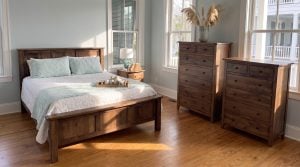
The guest room is usually the last room in the house to get furniture and the first one anybody judges. If you are shopping for a tall chest of drawers for a guest room ahead of the holidays, the short version is this: go up rather than out, so the floor stays clear, and buy something built from solid hardwood so it still earns its place when the room goes back to being a study in January. Here is how to size one, how to tell a well-built drawer from a weak one, and what to settle before you order.
What tall drawers for a bedroom actually solve
A guest room runs out of floor before it runs out of anything else. A long dresser takes four or five feet of wall; a tall chest holds a similar amount of clothing in about half that width by stacking the drawers instead of lining them up. What you get back is a clear path to the bed and enough wall left for a chair, a luggage rack or a lamp.
In older Charleston houses that matters more than it sounds. Bedrooms in a single house, or in an Old Village cottage in Mount Pleasant, get broken up by a window, a closet door and a door to the piazza, so the longest unbroken run of wall can be three feet. Height is the space you have left.
How tall is a question about the room and the people in it. Once the top drawer sits above your chest, you feel around in it rather than look into it, which is fine for spare blankets and poor for everyday shirts. A guest room can take the taller piece precisely because nobody dresses out of it every morning. Our guide to sizing a tall chest, tallboy or dresser for a Charleston bedroom works through it room by room.
Measure the wall, then measure the way in
Three numbers settle most of it. The width of the wall, minus a few inches so the chest is not wedged between a door casing and a baseboard. The height you can go before you reach a window sill, a chair rail or the slope of a converted attic ceiling. And the depth, plus about two feet of clear floor in front, so a full drawer can come all the way out while you stand there.
Then measure the way in: the front door, the hall, the turn at the top of the stairs, the bedroom door. A solid hardwood chest arrives built rather than flat-packed, so the piece that fits your wall still has to make the turn. Our white-glove team carries it to the room, sets it up and checks it over, and every piece is inspected before it ships, but a tight stair turn is worth mentioning when you order.
While the tape is out: a chest taller than it is wide belongs strapped to the wall, in case a child ever climbs an open drawer.
Open a drawer before you decide
The quickest way to judge a chest is to pull the middle drawer out and turn it over. The front of a piece tells you about taste; the drawer box tells you how long it lasts. Ask a specialist to do that with anything you are considering, and compare two pieces side by side. Here is what you are looking at:
- The corners. Interlocking dovetail joints hold a drawer together through decades of pulling. Staples and glue give up sooner.
- The sides and bottom. Solid wood sides and a substantial bottom panel stay square under a load of sweaters. Thin board wrapped in a printed wood pattern sags.
- What sits between the drawers. Dust panels, the horizontal dividers between one drawer and the next, stiffen the case and keep a drawer from spilling into the one below.
- The back. A fitted back panel keeps the case square when it is moved. A stapled-on sheet does not.
The solid wood chest of drawers buying guide goes through woods, joinery and drawer boxes in order if you want the long version, and it is worth knowing how to tell real wood from veneer and particleboard before you compare a piece you saw somewhere else.
Four decisions, made with a specialist
Nothing here comes off a shelf. A chest is built to order in a small Amish family workshop in Ohio, Pennsylvania or Indiana, never on a production line, so four choices come first: the wood, the finish, the hardware and the size. Nine hardwoods, including reclaimed barnwood and live edge. More than 180 finishes, or a color matched to something you already own. More than a thousand hardware styles, which is the decision people underestimate and the one that changes the look of a piece most.
Size is what makes building to order worth it in a guest room: if the only wall you have is 34 inches wide, the chest is 34 inches wide. You sit down with a furniture specialist, choose from the woods and the finishes we stock and match, and leave with a written specification and the build time for that piece, quoted with your order. Design help is complimentary, in the showroom or at your house.
Worth saying plainly: not every piece on our floor comes from an Amish workshop. The built-to-order hardwood furniture does, while much of the upholstery and the accents come from makers such as Smith Brothers, Rowe, Natuzzi, LuxCraft and Uttermost. The workshops themselves run on diesel, air and hydraulic power off the grid. What is different is the scale, a few hands in a shop rather than a line.
The rest of the guest room
A chest usually solves the room by itself, but one more piece finishes it. A blanket chest at the foot of the bed holds the extra quilt somebody always wants in a damp Lowcountry January, and it doubles as a bench for a suitcase. We wrote about choosing a solid wood blanket chest for exactly that job.
Then live with the humidity instead of fighting it. Solid wood takes on moisture in August and gives it back in January, which is why a drawer can feel snug in late summer and easy by Christmas. Keep the chest out of direct sun and away from a vent blowing straight at it, blot spills when they happen rather than wiping them, dust with a slightly damp cloth along the grain, and polish about once a month with a wax-free, silicone-free polish. Relative humidity between 25 and 45 percent keeps it steady. The full routine is on our furniture care page.
Start before the house fills up
Built to order means the clock starts when you order, not when you decide. If the guest room has to be ready for the holidays or a particular visit, plan early: a built-to-order piece carries a build time, so let a specialist tell you the current one for the piece you want, then work back from there. Charleston Amish Furniture has 35,000 square feet of showroom at 1750 Sam Rittenberg Boulevard in West Ashley, open Monday through Saturday, 10am to 6pm, closed Sunday. Bring your measurements and a photo of the room.
When the chest is finished it is inspected, delivered into the room it belongs in and set up by our white-glove team across the Lowcountry; call to confirm your address. If you would rather start with a question than a visit, get in touch with the showroom. Built once. Kept for good.
Frequently asked questions
How tall should a chest of drawers be in a guest room?
Let the wall and the user decide. A chest whose top sits around chest height stays easy to use and gives you a surface for a lamp; anything taller turns the top drawer into one you reach into blind, which is fine for spare bedding. In a guest room, where nobody dresses out of it daily, the taller piece is usually the better trade for floor space.
What is the difference between a tallboy and a chest of drawers?
A chest of drawers is the general term for a narrow case of stacked drawers. A tallboy, the British name for a chest-on-chest, is two cases built one above the other, so it stands taller and puts more storage on the same wall. A highboy is a tall chest raised on legs. A dresser is the wide, low piece built to sit under a mirror. The right one depends on the wall you have.
Do tall chests of drawers tip over?
Any piece that is taller than it is wide can tip if someone pulls out the upper drawers at once or a child climbs them. The answer is the same for every tall chest, however well it is built: strap it to the wall. It takes a few minutes, and it matters most in a guest room where visiting children may be in and out.
Can a chest of drawers be built to match a bed we already own?
Often, yes. Bring a photo and, if you can, a drawer front or a piece of the frame to the showroom so a specialist can work from the real finish rather than a screen. With more than 180 finishes plus color matching, and the size set to your wall, a built-to-order chest can be made to sit beside an older piece without looking like a stranger.
How long does a built-to-order chest of drawers take?
It depends on the workshop, the wood and what else is in that shop’s queue, so the honest answer comes with your order rather than from a web page. A specialist gives you the current build time for your piece in writing alongside the specification. If the room has a deadline, start the conversation early and work backward from it.